Subject: Clarification on “E-Motos” vs. “E-Bikes” and Why It Matters on School Property
1. The Difference Between E-Motos and E-Bikes
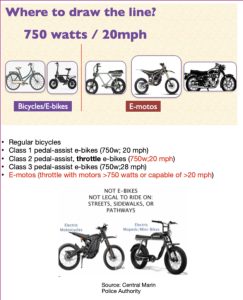
California law (Vehicle Code §312.5) defines an electric bicycle as a device with operable pedals and a motor of no more than 750 watts, providing-assistance only up to 20 mph for Class 2 (those with a throttle) or 28 mph for Class 3 (those without a throttle which require pedaling, which is assisted by the motor).. These are subject to specific age, helmet, and operational restrictions.
By contrast, if an electric two-wheeler with a throttle and a motor larger than 750 watts or capable of providing-assistance above 20 mph, it is not an electric bicycle. It is considered a motorcycle or other type of motor vehicle – for short, “e-motos.”. Many of them advertise motors exceeding 1,000 to 3,000 watts and top speeds between 30 and 50 mph. To be legally ridden on streets, they must be registered with the DMV, and the rider must possess a driver’s license and proof of insurance. To be registered, the DMV requires safety equipment (mirrors, lights, turn signals) that most of these are missing. It is obvious from the absence of license plates and the presence at middle schools that these requirements are being violated.
Confusion in this area is understandable, because numerous manufacturers and retailers have been selling these throttle-controlled, high-powered e-motos as e-bikes. The manufacturers have used social media influencers to create a culture luring children to these vehicles. Some even place “class 2 e-bike labels” on them, falsely claiming that they are limited to 20 mph even though their websites advertise much higher speeds.
Here is one example of an internet advertisement for one of brands of e-motos found at your schools.
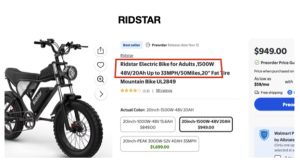
As one e-moto CEO candidly admitted, they are “flying under the radar” because they are quieter than the old-fashioned gas-powered mopeds that they simulate and because, until recently, no one knew how to classify them.
Fortunately, there is now a growing awareness among law enforcement, elected officials, school officials, the bicycle industry and advocacy groups that “the e-bike problem is an e-moto problem.” Here's a illustrative graphic:
2. What the “200 E-Motos” Figure Represents
The approximately 200 E-Motos referenced in the report: “E-Moto” Safety Assessment – San Ramon Valley Unified School District (Nov 1, 2025), reflects the number of illegal, out-of-class motorized vehicles or e-motos observed in middle-school bike corrals—not the total number of all electric bicycles. Legal Class 1 or 2 E-Bikes were present in smaller numbers, but the overwhelming majority of throttle-only, overpowered machines are brands that, based on their own advertisements, are clearly outside legal E-Bike classifications. In other words, the 200 figure represents the subset are non-compliant and not street legal for riders of any age.
3. Not Just Illegal, Also Dangerous
Marin County has been tracking 911 calls involving two wheelers, and reporting the data segregated by type (conventional and electric) and age group. The data show that youth 10-15 have 5 times the serious injury rate (serious enough to require transport to ER) of all other age groups, on electric devices even though their rate is only 1.5 for conventional bicycles. From counts at local Marin middle schools, we know that the vast majority of electric devices ridden by 10–15-year-olds are the e-motos, just like in SRVUSD.
4. Why E-Motos Should Not Be Parked on School Property
Whether viewed as a youth safety matter, or not aiding and abetting students in violating the law, or exposing the school district to potential liability, students should not be allowed to use illegal, dangerous e-motos for school transport or to park them on school property. Parking them alongside bicycles normalizes their use by unlicensed children, undermines both education and enforcement efforts, and creates serious safety risks in crowded pedestrian areas.
Schools would never permit students to park gas-powered dirt bikes or mopeds on campus. E- Motos are electrically powered versions of those same vehicles—and must be treated accordingly.
Parents should also be reminded that they face not only civil liability for damage and injuries caused by their children but can face criminal liability for allowing unlicensed juveniles to drive vehicles like these. The Central Marin Police Authority has recently charged a parent with child endangerment for allowing use of an e-moto that the child crashed.